Solid Wood Machining for Custom Furniture
Solid wood machining asks for dimensional control and an understanding of how the material behaves, at the same time. Timber brings grain, density variation, internal stress and moisture sensitivity, all of which affect the machining strategy.
Machining it well is less about the machine than about the decisions made before the part reaches it.
Where solid wood is the right choice
Solid timber is particularly suitable where the piece must be repairable over a long service life, where the edge or profile is genuinely three-dimensional, and where the appearance and feel of solid wood are central to the design.
It is a harder case to make on a tight budget where a veneered panel would meet the same visual requirement, and in high-humidity environments without a construction designed for movement. Large flat solid-wood panels are possible, but they call for careful stock selection and a construction that accommodates moisture movement.
Start with stock selection, not machine time
Board selection has a major influence on the result. Check stock flatness and thickness variation before machining as well.
Species sets density, hardness, how cleanly it machines and how it takes finish. Oak, ash, birch and walnut all behave differently under the same cutter, so tooling, feeds, speeds and cutting depths are worth rechecking whenever the species or the stock condition changes.
Moisture content has to suit the destination. Timber machined at the wrong moisture content will move afterwards, and later moisture changes can take a part outside its specified tolerances.
Cut and grain determine stability. For the same species and the same moisture change, quarter-sawn boards generally move less across their width than flat-sawn ones.
Defects and character. Knots, colour variation and figure are either the design or the problem. That has to be stated, because a knot is a defect in one project and the reason for the commission in another. Under our terms, knots in solid wood are a natural characteristic rather than a fault unless the brief states otherwise. That is a contractual position, not a structural one: knots in loaded sections still need thinking about.
Where a piece is glued up from several boards, board matching becomes a specification item too: grain direction, colour and the position of joints in the finished panel.
Grain direction is not a cosmetic detail
It is a machining parameter.
Cutting direction relative to grain determines tear-out, edge crispness and surface quality. Climb and conventional milling produce different results on the same profile in the same timber. Figured or interlocked grain may call for changes to cutting direction, tool geometry and the allowance left for a finishing pass.
Grain also decides where a part is strong. Narrow sections with short grain can split or break, depending on geometry and loading.
Specify grain direction wherever it affects appearance, strength or movement. Those requirements come before nesting efficiency, and if nothing is specified, nesting is what ends up deciding.
Design for the cutter
Several details that are trivial in a drawing are expensive or impossible in timber.
Internal corners cut with an end mill keep a radius set by the cutter. If a square-edged component must seat into that corner, the drawing needs relief, and that relief has to give assembly clearance without weakening the surrounding material.
Small radii on hardwood mean a small cutter, which means light passes and more machining time, depending on pocket depth and tool access. It is worth asking whether the smaller radius is visible in the finished piece.
Deep pockets and thin walls are a stability question. Material removed from one face releases internal stress, and a part can cup after machining even though it was flat when it went on the table.
Three-dimensional profiles are where solid wood justifies CNC. Carved reliefs, shaped edges and sculpted forms repeat consistently across a run. We machine on three axes: feasibility depends on tool access and some forms need several setups. We do not offer five-axis machining, and where a form genuinely requires it we say so rather than approximating.
Workholding and part stability
Workholding affects both feasibility and machining time.
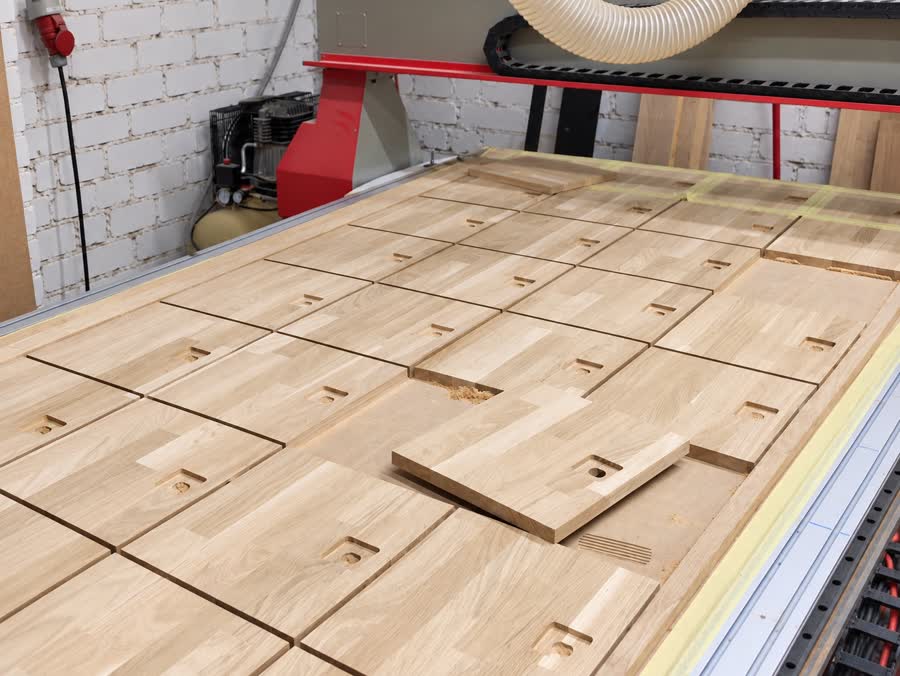
Stock flatness and thickness variation have to be checked before the part goes on the table. Holding it securely without marking the visible face, keeping it stable as material is removed, and preventing small parts from moving on the final pass are all real constraints on what can be machined and how quickly.
This affects design: a part with no sensible holding area, or one that becomes unsupported before the last cut, may need extra stock, tabs, or a fixture. Leaving machining allowance around a part is frequently cheaper than developing a more complex fixture.
Tolerances that account for movement
A tolerance on a timber part is only meaningful together with a moisture assumption.
Our base machining tolerance is ±0.5 mm, comparable with ISO 2768-1 class m for nominal dimensions over 120 mm and up to 400 mm. Tighter tolerances are available on request and are agreed per part. That tolerance applies to the machined part; what it measures weeks later in a different building depends on humidity.
Plywood moves roughly 0.002 mm per millimetre of width for every 10-percentage-point change in relative humidity. Solid wood moves considerably more, and almost entirely across the grain rather than along it. Movement in a solid panel has to be estimated from its species, grain orientation and the expected moisture-content range, not from the plywood figure.
The practical consequence is that joints have to be designed to accommodate movement rather than to resist it: floating panels, elongated fixing holes, allowance where a solid element meets a rigid one.
Joinery and movement work together
Traditional timber joinery combines load transfer with an allowance for movement, and the reasoning still applies when the joints are cut by machine.
Frame-and-panel construction lets a panel move inside a stable frame. Breadboard ends can control cupping in a top, provided their joints let it expand and contract across its width. Slotted fixings let a solid top sit on a rigid base without splitting.
CNC makes these joints faster and more repeatable. It does not make them unnecessary. A wide solid panel glued rigidly to a frame can split or pull its joints apart when cross-grain movement is restrained, no matter how accurately the parts were cut.
Finishing is part of the manufacturing plan
Machining strategy affects the finish before any coating is applied.
Tool condition, feed rate and cutting direction determine whether a surface needs light sanding or extensive work. A part machined with a worn cutter can take enough additional sanding to offset any machining time saved.
Finish also affects dimensions. Film-building systems add measurable thickness, which matters on a press fit or a close-fitting drawer. Allow for coating thickness on close-fitting surfaces, and say which mating or glue surfaces are to stay uncoated.
Decide the finish before machining, not after.
What to prepare before sending a project
Next step: tell us the species and what the piece has to do. CNC milling and cutting · work we have done · file preparation guide
22.09.2026